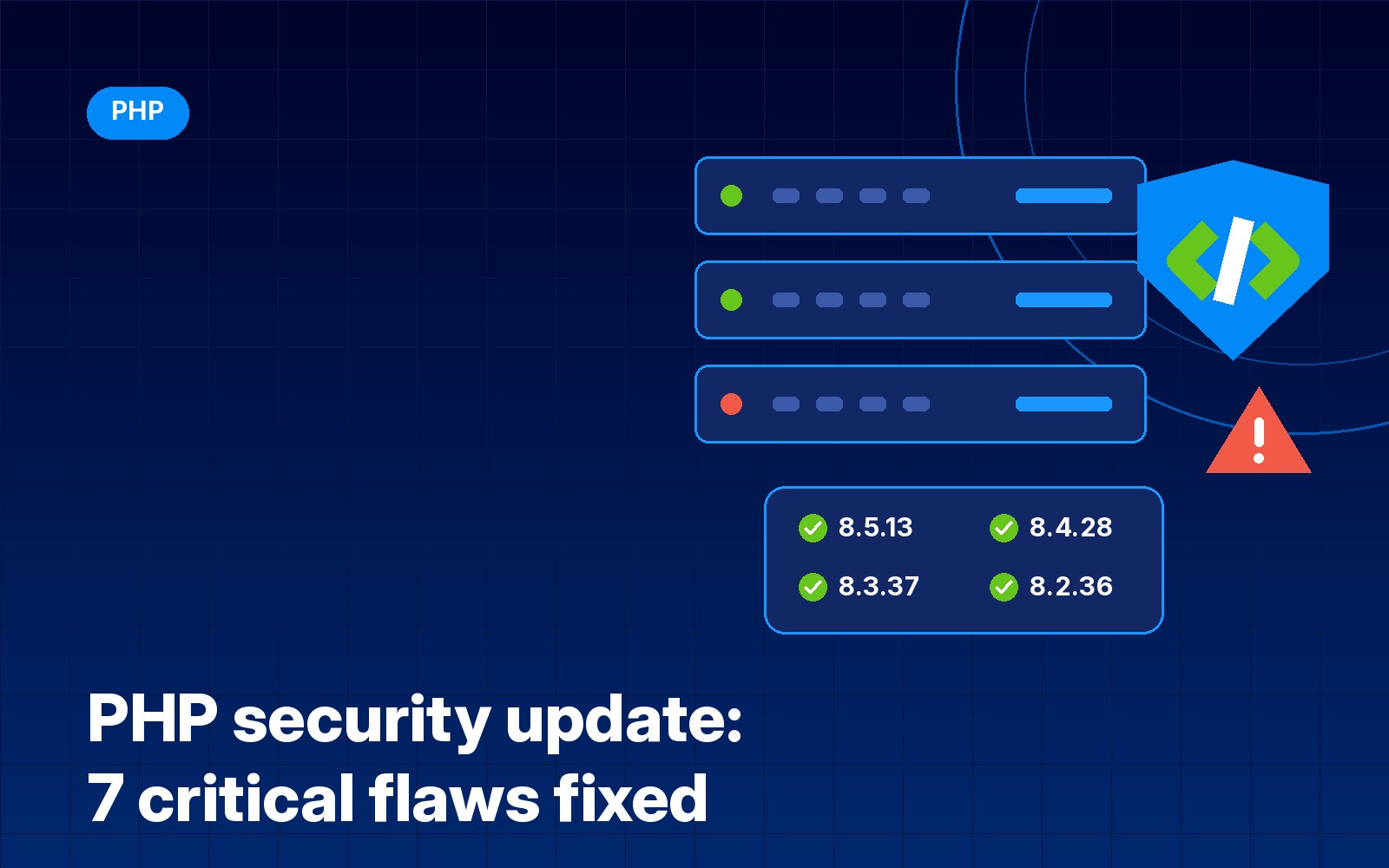
On Thursday 19 November 2026, the PHP team released security updates for every supported version of PHP: PHP 8.5.13, 8.4.28, 8.3.37 and 8.2.36. According to NHS England’s cyber alert, they fix 18 vulnerabilities in total, seven of them rated critical, and some of those could let an attacker run their own code on a web server.
It’s the second big PHP security release in a month, coming just four weeks after the PHP2Shell flaws. If your website runs on WordPress, Joomla or anything else built with PHP, here’s what you need to know and what to do about it, in plain English.
What was fixed?
The official PHP changelog lists fixes across the PHP engine itself, PHP-FPM (the part that most web servers use to run PHP), session handling, and the SOAP, Phar, DOM and date extensions. NHS England lists seven critical issues, each scored 9.2 out of 10 (CVSS v4):
- CVE-2026-129289: PHP-FPM request smuggling. On some server setups, an attacker can sneak a second, forged request in behind a normal one and get PHP to run code of their choosing.
- CVE-2026-126714: session files that are only partly overwritten can be abused to inject data, which may lead to code execution.
- CVE-2026-115560: a session serializer mismatch that can also lead to code execution. PHP first warned about this one in an advisory on 23 October.
- CVE-2026-129496: a timezone cache use-after-free (a memory bug) that can crash PHP workers and, in some cases, allow code execution.
- CVE-2026-129474 and CVE-2026-129182: use-after-free bugs linked to error backtraces. These only affect PHP 8.5.
- CVE-2026-129481: a use-after-free after an interrupted session shutdown, affecting PHP 8.3, 8.4 and 8.5.
Other fixes cover a PHP-FPM bug that could allow local privilege escalation (CVE-2026-129291), a Phar signature bypass (CVE-2026-128090), and issues that could cause crashes, leak data or expose HTTPS and FTPS addresses as plain text. BleepingComputer has a good round-up of the full list.
How worried should you be?
The honest answer is: take it seriously, but don’t panic. When PHP announced the release a day early, its security team said the critical issues “require either non-default configuration or uncommon setups”. For example, the request smuggling flaw only works where the web server reuses its connections to PHP-FPM, which isn’t the default in nginx or Apache.
Several of the session bugs also depend on a feature called session upload progress being switched on, or on unusual session settings. Many small business sites won’t be set up that way.
However, NHS England says it’s aware of multiple public proof-of-concept exploits, meaning working examples of how to attack these flaws are already out there, and it rates future attacks as “a realistic possibility”. You can’t always know exactly how your host has configured PHP, so the safe approach is to make sure you’re on a fixed version.
Which versions are safe?
You need to be on at least these versions, depending on which branch your site uses:
| Your PHP branch | Fixed version | Security fixes until |
|---|---|---|
| 8.5 | 8.5.13 | 31 Dec 2029 |
| 8.4 | 8.4.28 | 31 Dec 2028 |
| 8.3 | 8.3.37 | 31 Dec 2027 |
| 8.2 | 8.2.36 | 31 Dec 2026 |
The support dates come from php.net’s supported versions page. The brand new PHP 8.6.0, also released on 19 November, includes these fixes too.
PHP 8.1 and older are past end of life and don’t get official fixes. AWS points out that some of these issues, including the request smuggling flaw, do affect those old versions. Some Linux distributions and third parties offer patched packages for old PHP, but the real fix is to move to a supported version.
Do I need to update WordPress or Joomla?
Not for this. These are bugs in PHP itself, the language your website runs on, not in WordPress, Joomla or your plugins. Updating your site won’t fix them. The update has to be done on the server. That said, it’s still worth keeping WordPress up to date, as my post on the WordPress 7.1.5 security release explains.
What to do now
- Check your PHP version. In WordPress, go to Tools, then Site Health, then the Info tab, and open the Server section. In Joomla, go to System, then System Information. Your hosting control panel will show it too.
- On shared or managed hosting: most good hosts apply PHP security updates for you within a few days. If your version number is still below the fixed versions above, contact your host and ask when it will be patched.
- On your own server or VPS: update PHP through your package manager, EasyApache in cPanel, or the PHP settings in Plesk, then restart PHP-FPM or your web server so the new version is actually running.
- If you can’t patch straight away: PHP and BleepingComputer suggest two temporary measures. Turn off session upload progress by setting
session.upload_progress.enabled=0and restarting PHP, and stop your web server reusing connections to PHP-FPM (for examplefastcgi_keep_conn offin nginx). These only reduce the risk; they don’t fix every flaw. - Make sure PHP-FPM isn’t exposed to the internet. It should only accept connections from your own web server, never from the outside world.
Still on PHP 8.2? Plan your upgrade now
If your site is on PHP 8.2, this update keeps you safe for now, but 8.2 stops getting security fixes on 31 December 2026. After that, the next batch of fixes won’t come to 8.2 at all. My guide to PHP 8.2 reaching end of life walks through how to check your plugins and move to PHP 8.3 or 8.4 safely.
It’s also worth remembering that PHP isn’t the only software on your server that needs patching. This month’s critical Apache HTTP/2 flaw is a good example of why the whole server needs looking after, not just the website.
Sources
- PHP.net: release announcements, 19 November 2026
- PHP.net: PHP 8 ChangeLog
- NHS England Digital: PHP Releases Updates for Multiple Vulnerabilities (CC-4900)
- BleepingComputer: PHP security updates fix 18 flaws, including critical RCE bugs
- AWS: PHP Foundation Security Releases, November 19, 2026
Need help?
I look after websites and servers for small businesses in Milton Keynes and across the UK, including keeping PHP patched and upgrading old versions safely. If you’re not sure whether your site is up to date, get in touch.